Friday, 27 June 2008

BOOM

The "piece" that holds the sail together and from which the windsurfer/boardsailor hangs or hooks onto.

I am somewhat surprised there are not more variations on the current booms. They come in various materials like aluminum or carbon, regular diameter or thinner, have various adjustable lengths, some have larger tail pieces like for formula and some booms are a little narrower. The most important piece seems to be mast head - where the boom attaches to the mast. Here some companies like MauiSails have made a name for themselves. North Sails also have some kinda flex head that allows one to make it very stiff or soft. Apparently lighter winds require a looser connection for speed.

Whatever you do, check your equipment each time you go out and look for the non-standard as well. My HPL mast-head rope came off while I was planing with a MauiSails TR-4 10-oh sail. Suddenly I found myself face down on the board with no idea why. Tied the mast head back on and got ready to go out again since it was such a nice day. That was when I noticed that I had punched a hole in the deck with my harness hook. Obviously by now, water had gone in @#$%^&*( Was I supposed to cry at this point ? Brought it straight to the repair-man while still in my wetsuit. When he told me he could do it for $40 no issues, I told him was my new best friend :-) He used carbon re-enforcement and it feels harder than the original board now.

There are new materials coming out now that are to be a match for the carbon booms for less money.

For larger sails and heavier individuals they say carbon booms are the way to go. (Not sure if this applies to smaller sails and lighter sailors) It seems the goal is to have a "stiffer" boom with a  tight mast head connection for the good winds. What I find helps and is documented on forums is to not have the mast tail piece too far extended ie try to keep the boom near minimum extension when possible. If you have a carbon boom and it is at maximum extension, you are not getting the full benefit of the carbon stiffness.

I purchased an HPL boom used from Ottawa for about $230 of lengths 220-280 in order to be able to purchase a used MauiSails TR 10.0 sail. Bruce Peterson of Sailworks confirmed the boom is on a CARBON boom and suggested the arms near the head get a carbon re-enforcement.This was done for about $80. Thus, I now had a strong carbon boom for about $300 which was good for my 8.5 and 10-oh. I like it very much with both sails and wonder if I can tell the difference on the 8.5 It seems better in higher winds. Articles suggest tighter booms in higher winds and that might be the difference i.e. not noticeable in lighter winds ...

So, people attach harness lines on the boom and some use adjustable outhaul. This adjustable allows the sailor to change the shape of the sail on the fly. The uphaul cord attaches to the boom as well. Basically to me, it feels like the boom holds it all together and has the most cord attachments ...

If you get hit with a boom or mast - boom , boom, out go the lights = wear a helmet in bigger winds.

This fellow made his own boom: How-to-make-a-carbon-windsurf-boom

This HPL carbon boom had some carbon added to it at the masthead. This was done based on Sailworks Bruce Peterson's recommendation.  He stated this will give this great boom a really long and healthy life !!

clique to enlarge
Carbon booms are NOT cheap and can break. There are still aluminum booms and now they are making booms that rival the carbon booms. A carbon boom can cost $800 +. They say it may not be required unless one is using larger sails than 8.5 and/or one is a heavyweight - in that case you will probably be using 8.5+ sails anyway !!!

In case someone needs to know how to rig a boom that has no clamp - here are some instructions:
http://cid-c6db8ade6b0c768c.office.live.com/view.aspx/Documents/How%20to%20rig%20an%20old%20boom%20with%20the%20wrap.doc

In case anyone has an HPL boom and wants to change the red clamps near and for the tail - i found a post on iwindsurf on the subject with the following details:

http://www.iwindsurf.com/forums/viewtopic.php?t=23056&postdays=0&postorder=asc&start=10 

Some years back before HPL stopped making booms, I picked up a replacement set of adjustment pin assemblies from Derrick Ho. You may want to contact Maclean Quality Composites in Utah to find out whether Derrick or some other representative can help you out.

http://investing.businessweek.com/research/stocks/private/snapshot.asp?privcapId=24229888
 

BOOM

The "piece" that holds the sail together and from which the windsurfer/boardsailor hangs or hooks onto.

I am somewhat surprised there are not more variations on the current booms. They come in various materials like aluminum or carbon, regular diameter or thinner, have various adjustable lengths, some have larger tail pieces like for formula and some booms are a little narrower. The most important piece seems to be mast head - where the boom attaches to the mast. Here some companies like MauiSails have made a name for themselves. North Sails also have some kinda flex head that allows one to make it very stiff or soft. Apparently lighter winds require a looser connection for speed.

Whatever you do, check your equipment each time you go out and look for the non-standard as well. My HPL mast-head rope came off while I was planing with a MauiSails TR-4 10-oh sail. Suddenly I found myself face down on the board with no idea why. Tied the mast head back on and got ready to go out again since it was such a nice day. That was when I noticed that I had punched a hole in the deck with my harness hook. Obviously by now, water had gone in @#$%^&*( Was I supposed to cry at this point ? Brought it straight to the repair-man while still in my wetsuit. When he told me he could do it for $40 no issues, I told him was my new best friend :-) He used carbon re-enforcement and it feels harder than the original board now.

There are new materials coming out now that are to be a match for the carbon booms for less money.

For larger sails and heavier individuals they say carbon booms are the way to go. (Not sure if this applies to smaller sails and lighter sailors) It seems the goal is to have a "stiffer" boom with a  tight mast head connection for the good winds. What I find helps and is documented on forums is to not have the mast tail piece too far extended ie try to keep the boom near minimum extension when possible. If you have a carbon boom and it is at maximum extension, you are not getting the full benefit of the carbon stiffness.

I purchased an HPL boom used from Ottawa for about $230 of lengths 220-280 in order to be able to purchase a used MauiSails TR 10.0 sail. Bruce Peterson of Sailworks confirmed the boom is on a CARBON boom and suggested the arms near the head get a carbon re-enforcement.This was done for about $80. Thus, I now had a strong carbon boom for about $300 which was good for my 8.5 and 10-oh. I like it very much with both sails and wonder if I can tell the difference on the 8.5 It seems better in higher winds. Articles suggest tighter booms in higher winds and that might be the difference i.e. not noticeable in lighter winds ...

So, people attach harness lines on the boom and some use adjustable outhaul. This adjustable allows the sailor to change the shape of the sail on the fly. The uphaul cord attaches to the boom as well. Basically to me, it feels like the boom holds it all together and has the most cord attachments ...

If you get hit with a boom or mast - boom , boom, out go the lights = wear a helmet in bigger winds.

This fellow made his own boom: How-to-make-a-carbon-windsurf-boom

This HPL carbon boom had some carbon added to it at the masthead. This was done based on Sailworks Bruce Peterson's recommendation.  He stated this will give this great boom a really long and healthy life !!

clique to enlarge
Carbon booms are NOT cheap and can break. There are still aluminum booms and now they are making booms that rival the carbon booms. A carbon boom can cost $800 +. They say it may not be required unless one is using larger sails than 8.5 and/or one is a heavyweight - in that case you will probably be using 8.5+ sails anyway !!!

In case someone needs to know how to rig a boom that has no clamp - here are some instructions:
http://cid-c6db8ade6b0c768c.office.live.com/view.aspx/Documents/How%20to%20rig%20an%20old%20boom%20with%20the%20wrap.doc

Tuesday, 27 May 2008

Accessories

If you think boards, mast bases, mast extensions, masts, booms, sails and fins are enough, your are sorrily mistaken :-( There are plenty of other things that can make your windsurf life MUCH easier or more pleasant.

Because windsurf equipment - especially boards are NOT small, there needs to be storage and transportation considerations... If you live in an area where things get "colder", you can extend your season with what I call "rubber suits". There are also all kinds of little gadgets, which are handy to carry in a kit or bag.

Storage and Transportation: If you windsurf at a lake and have a chalet, the basement is usually a good option. Personally do NOT recommend leaving equipment outside. A tree lost a branch causing a repair on my old F2 Comet 330. This was considered lucky since my much softer shortboard was less than ten (10) feet away. In the garage people use racks, hooks, etc. In apartments, I imagine you need an extra corner or racks, hooks, etc. For transportation a vehicle is useful, as are racks, quiver bags, etc. Personally have a van with roof racks and a sail / mast quiver bag for the roof to move all the stuff with family about. I have seen forum discussions about people like Robby Naish using a hearse to transport his stuff, etc. Naturally there are always the crazies with Smart cars, carts with bicycles, etc... Just make sure nothing blows off the top of your vehicle nor punches a hole in your back window !!! Use the good straps and not the cheap ones !! Mine came from a kayak shop and I see windsurf shops in the area are now starting to carry them as well...The following is NOT my van, but shows what lengths people go to ...

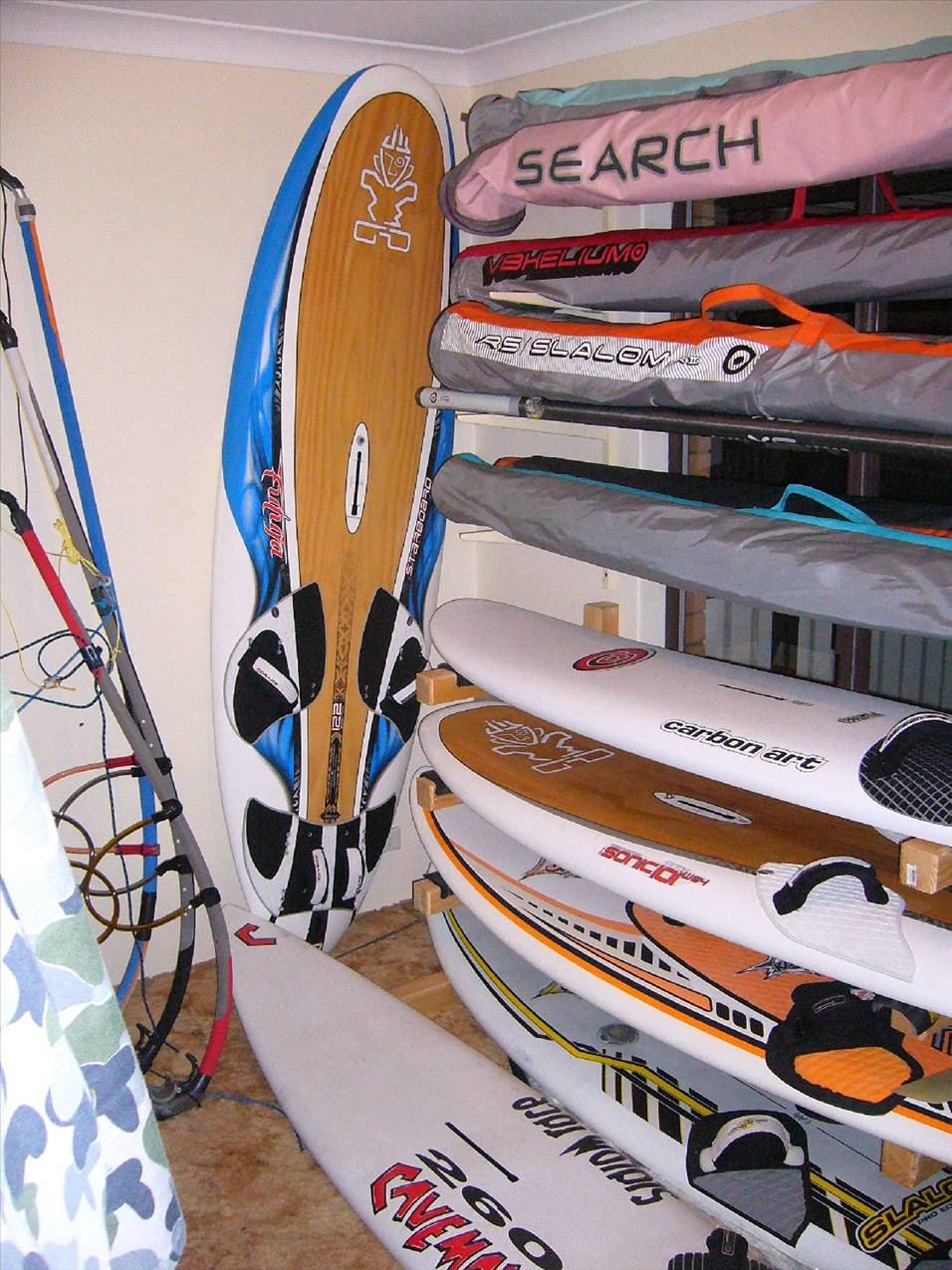
and here are some garage storage ideas: {once again - NOT mine in the image}
http://www.seabreeze.com.au/forums/Windsurfing/General/Board-Gear-racks-for-the-garage/

Special clothing: Naturally people go to all kinds of extremes here, and there are always the minimalists. Please do NOT go windsurfing naked. You are bound to upset someone and may get a ticket. Booties at the very least can help your feet when on rough or yucky terrain. Bathing suits tend to keep the curious and nibbling fish away as well. T-shirts and sunscreen help the ever more powerful sun rays. Some like the sunglasses as well - strongly suggest some kind of attachment. Personally have an old pair of prescription glasses that I wear sailboarding. As it starts to get cooler, people like to wear shorties. When it gets cold, the "rubber suits" come out. There are wetsuits and drysuits and some seem more suited to windsurfing than others. Personally find wetsuits of a 4/3 thickness are more than enough for my local conditions. Get information from others in the area and from shops, forums, etc as well. Gloves and hoods are recommended as well when required. BTW/by the way, if you have never put on a "rubber suit", be forewarned, they are NOT easy to put on AND need to be peeled off inside out !! Since I have started reaching faster speeds and hit my head a few times, I am now a true follower of the helmet religion. In light winds, I may not use it, but mid winds with 7.0 and down I strongly recommend a helmet...Here is an image of a special pair of gloves that make a lot of sense. If you have ever used gloves windsurfing, you will know what I mean...


Did I forget to mention "life jacket" or PDF/personal floating device? Personally, hate em! Apparently there may even be a law - enforced? It does help when learning water starting AND when you are panicking while stuck in the harness lines under your sail :-) Don't panic - wear a life jacket.

Harness: Personally do not consider this a piece of clothing, but a necessary piece of the planing setup. There are seat and waist harnesses with different types of hooks. They used to say seat harnesses were for racing and waist for all the "cool windsurfing" like wave, free-style, bump n jump, etc. Those ideas do not hold water any more and people use whatever they are comfortable with or have always used. One cannot stress enough that the harness MUST be comfortable for YOU... The same goes for harness lines. People can suggest putting them back 1/3 on the boom and close together. You need to put them where you feel comfortable and then gradually move them about... Seats like the following are almost a mix of the seat and waist harness in the sense there are fewer seat harnesses with the uncomfortable straps...


Tool kit or bag: In a Windsurf Magazine article they showed all the goodies inside Bruce Peterson of Sailwork's toolkit. Many items were to ensure he could get back on the water no matter what - like Ding Stik for board repair. Others were to help setup for the day - like a marine lubricant called Sailkote. See  Bruce's Tool Box Gear Guide In my tool bag I have screwdrivers for fins et al., Sailkote, one handed down-haul tool, measuring tape (metric and imperial), sharp blade, lighter for nylon ropes, hex keys for battens, markers to mark regularly used lengths,electrical tape, triple pulley with hook for older sails, bungee cords, light gloves and some spares discussed in next section. In the van I keep the keys to the chalet and my windsurf prescription glasses. Other suggestions are peroxide and band-aids. Some people just have a first aid kit in the car. I have a list of things to bring when I go windsurfing that are NOT in the bag, like money, cell-phone, and my favourite suggestion: sunbath. You fill it with water and leave it in the sun. When you have finished sailing, you take a nice warm shower - very useful on cooler or colder days/daze !!! A really handy thing is to have a list in the tool bag of what you need to bring to the water. I break it down by light, mid and heavy wind as I do not have enough space for everything at once. {when it is time to go, I am usually so excited that I would forget a critical piece without my list(s) !!!} My wife says i love windsurfing more than her. Just do not understand why she gets so upset when I don't argue the point :-(   :-) One thing I always forget to put in the bag AND forget to put on is sunblock. Have had to stop windsurfing becuz I was too burnt :-(

Spares: Cannot stress enough NOT to lose the nut from the mast-base OR make sure you have spare %^&*( Nothing worse than missing a session because you lost it !! If the harness lines are getting old, put a new pair in the toolkit. I carry a spare mast-base as well. If the tendon on one breaks, I am back on the water in no time at all... I also keep a six (6) foot length of down-haul rope in the kit. Also have a really old up-haul cord - JUST IN CASE.. Other suggestions include the screw that goes in the fin. Personally have never had an issue with this {did i just jinx myself %^&*(}

Repairs: I have used Chinook ReDek , SolarEZ and MarineTek for board repairs. On sails I used to use duct tape, but that is NOT a good solution. You can buy monofilm rolls and they are not expensive. My fins are repaired in the off-season and as such I do not carry files, sandpaper, etc.

Others: Some things not mentioned and which I do not have include: mast base pad, mast base tendons and/or universal joint , washers and/or O-rings, water starter pad, easy-uphaul for the back and perhaps even spare footstraps. A fun thing to have (for some essential) is a wind meter. There are hand held digital versions and i used to use a ping pong ball on a compass where degrees determined wind speed. There is an app on the ipod that seems to have gained popularity as well.


If you have too much money and jump too high, perhaps you need a shadowbox ?


You think you are too fast? Get yourself a waterproof GPS - people log their speeds all over the world.

Accessories

If you think boards, mast bases, mast extensions, masts, booms, sails and fins are enough, your are sorrily mistaken :-( There are plenty of other things that can make your windsurf life MUCH easier or more pleasant.

Because windsurf equipment - especially boards are NOT small, there needs to be storage and transportation considerations... If you live in an area where things get "colder", you can extend your season with what I call "rubber suits". There are also all kinds of little gadgets, which are handy to carry in a kit or bag.

Storage and Transportation: If you windsurf at a lake and have a chalet, the basement is usually a good option. Personally do NOT recommend leaving equipment outside. A tree lost a branch causing a repair on my old F2 Comet 330. This was considered lucky since my much softer shortboard was less than ten (10) feet away. In the garage people use racks, hooks, etc. In apartments, I imagine you need an extra corner or racks, hooks, etc. For transportation a vehicle is useful, as are racks, quiver bags, etc. Personally have a van with roof racks and a sail / mast quiver bag for the roof to move all the stuff with family about. I have seen forum discussions about people like Robby Naish using a hearse to transport his stuff, etc. Naturally there are always the crazies with Smart cars, carts with bicycles, etc... Just make sure nothing blows off the top of your vehicle nor punches a hole in your back window !!! Use the good straps and not the cheap ones !! Mine came from a kayak shop and I see windsurf shops in the area are now starting to carry them as well...The following is NOT my van, but shows what lengths people go to ...


Special clothing: Naturally people go to all kinds of extremes here, and there are always the minimalists. Please do NOT go windsurfing naked. You are bound to upset someone and may get a ticket. Booties at the very least can help your feet when on rough or yucky terrain. Bathing suits tend to keep the curious and nibbling fish away as well. T-shirts and sunscreen help the ever more powerful sun rays. Some like the sunglasses as well - strongly suggest some kind of attachment. Personally have an old pair of prescription glasses that I wear sailboarding. As it starts to get cooler, people like to wear shorties. When it gets cold, the "rubber suits" come out. There are wetsuits and drysuits and some seem more suited to windsurfing than others. Personally find wetsuits of a 4/3 thickness are more than enough for my local conditions. Get information from others in the area and from shops, forums, etc as well. Gloves and hoods are recommended as well when required. BTW/by the way, if you have never put on a "rubber suit", be forewarned, they are NOT easy to put on AND need to be peeled off inside out !! Since I have started reaching faster speeds and hit my head a few times, I am now a true follower of the helmet religion. In light winds, I may not use it, but mid winds with 7.0 and down I strongly recommend a helmet...Here is an image of a special pair of gloves that make a lot of sense. If you have ever used gloves windsurfing, you will know what I mean...


Did I forget to mention "life jacket" or PDF/personal floating device? Personally, hate em! Apparently there may even be a law - enforced? It does help when learning water starting AND when you are panicking while stuck in the harness lines under your sail :-) Don't panic - wear a life jacket.

Harness: Personally do not consider this a piece of clothing, but a necessary piece of the planing setup. There are seat and waist harnesses with different types of hooks. They used to say seat harnesses were for racing and waist for all the "cool windsurfing" like wave, free-style, bump n jump, etc. Those ideas do not hold water any more and people use whatever they are comfortable with or have always used. One cannot stress enough that the harness MUST be comfortable for YOU... The same goes for harness lines. People can suggest putting them back 1/3 on the boom and close together. You need to put them where you feel comfortable and then gradually move them about... Seats like the following are almost a mix of the seat and waist harness in the sense there are fewer seat harnesses with the uncomfortable straps...


Tool kit or bag: In a Windsurf Magazine article they showed all the goodies inside Bruce Peterson of Sailwork's toolkit. Many items were to ensure he could get back on the water no matter what - like Ding Stik for board repair. Others were to help setup for the day - like a marine lubricant called Sailkote. See  Bruce's Tool Box Gear Guide In my tool bag I have screwdrivers for fins et al., Sailkote, one handed down-haul tool, measuring tape (metric and imperial), sharp blade, lighter for nylon ropes, hex keys for battens, markers to mark regularly used lengths,electrical tape, triple pulley with hook for older sails, bungee cords, light gloves and some spares discussed in next section. In the van I keep the keys to the chalet and my windsurf prescription glasses. Other suggestions are peroxide and band-aids. Some people just have a first aid kit in the car. I have a list of things to bring when I go windsurfing that are NOT in the bag, like money, cell-phone, and my favourite suggestion: sunbath. You fill it with water and leave it in the sun. When you have finished sailing, you take a nice warm shower - very useful on cooler or colder days/daze !!! A really handy thing is to have a list in the tool bag of what you need to bring to the water. I break it down by light, mid and heavy wind as I do not have enough space for everything at once. {when it is time to go, I am usually so excited that I would forget a critical piece without my list(s) !!!} My wife says i love windsurfing more than her. Just do not understand why she gets so upset when I don't argue the point :-(   :-) One thing I always forget to put in the bag AND forget to put on is sunblock. Have had to stop windsurfing becuz I was too burnt :-(

Spares: Cannot stress enough NOT to lose the nut from the mast-base OR make sure you have spare %^&*( Nothing worse than missing a session because you lost it !! If the harness lines are getting old, put a new pair in the toolkit. I carry a spare mast-base as well. If the tendon on one breaks, I am back on the water in no time at all... I also keep a six (6) foot length of down-haul rope in the kit. Also have a really old up-haul cord - JUST IN CASE.. Other suggestions include the screw that goes in the fin. Personally have never had an issue with this {did i just jinx myself %^&*(}

Repairs: I have used Chinook ReDek , SolarEZ and MarineTek for board repairs. On sails I used to use duct tape, but that is NOT a good solution. You can buy monofilm rolls and they are not expensive. My fins are repaired in the off-season and as such I do not carry files, sandpaper, etc.

Others: Some things not mentioned and which I do not have include: mast base pad, mast base tendons and/or universal joint , washers and/or O-rings, water starter pad, easy-uphaul for the back and perhaps even spare footstraps. A fun thing to have (for some essential) is a wind meter. There are hand held digital versions and i used to use a ping pong ball on a compass where degrees determined wind speed. There is an app on the ipod that seems to have gained popularity as well.


If you have too much money and jump too high, perhaps you need a shadowbox ?


You think you are too fast? Get yourself a waterproof GPS - people log their speeds all over the world.

Sunday, 27 April 2008

Jim Drake's Windsurf Physics

By chance I came upon this and felt it would be better presented if the figures were in the document. Jim Drake is synonymous with windsurfing and now works or consults Starboard. The original link was drake_chronicles.

Although this discussion is toned down for the masses, it still makes me smile cuz for me it's simple - water, wind and I :-)

================================================================

An Introduction to the Physics of Windsurfing
Jim Drake – 2005 

All sailboats including windsurfers use the wind for propulsion. Windsurfers differ greatly from all other sailboats, however, in three respects. First, the forces that are captured by the sail and that drive the board forward all go through the sailor -- literally. Second, the weight of the hull, the sail, the mast and everything else is far less than the weight of the sailor who controls it. And finally, even in zero wind the sailor can make substantial headway by “pumping” the sail from side to side, using it as an “air oar” or, more accurately, like a bird’s wing. The first two features are explained in this paper. The last, “pumping”, will not be further be treated except to note that current Olympic competitors use this technique extensively in the often light wind conditions that seem to plague the Games.
In Figure 1 Kevin Pritchard, the 2004 World Champion, demonstrates the first of the features described above. He literally holds the wind in his hands and directs the sail’s power to the board through his arms and legs. He controls the force and direction -- throttle and steering wheel -- with his grip on the boom. In this way he is both motor and pilot. This paper will discuss the physics of windsurfing in two parts. Part I summarizes the forces and moments that act on the board and rig as a whole. This section is intended for a general audience and is not as complete or as careful as some might wish. It trades precision for what I hope is improved clarity. Part II translates the forces described in Part I into velocity vectors. This necessarily requires additional background for its understanding in the field of fluid dynamics. Thus it’s not for everyone though the figures in this section can give a degree of insight even if the theory behind them is likely to be opaque to the general reader.

Part I – Forces and Moments
Kevin is back again on Figure 2. It shows the kinds of forces that nature confronts him with. His natural skills allow him to sense and react to these forces without really thinking about them. Most windsurfers are the same way but some, like myself and those to whom this paper is aimed, find that an analytical understanding is fun in itself and often helpful on the water.
The main forces can be grouped roughly into five categories:

  1. Hydrodynamic lift acting upward on the bottom of the board,
  2. Gravitational weight acting downward through the center-of-gravity (c.g.) of the combined mass of the   board, rig and sailor,
  3. Hydrodynamic side force acting sideways almost entirely on the fin (or fins in the case of a board with a centerboard) in reaction to sideways component of the
  4. Aerodynamic wind force acting on the sail at its center-of-pressure (c.p.) and
  5. Hydrodynamic drag on the board balancing the forward component of the wind on the sail.

The sideways component of the aerodynamic force on the sail is called heel; the forward component is referred to as drive. A useful method for the analysis of forces on a body (in this case the body is the combination of board, rig and sailor) is that if the forces and moments acting on that body in two orthogonal (perpendicular) planes sum to zero, the body is moving at constant velocity. This is called “steady state” and is by far the easiest case to analyze.
This method is applied to a vertical plane perpendicular to the direction of travel in Figure 3. This is also called the lateral plane. The forces pictured on figure 2 that Kevin has to cope with and which have a component in the lateral plane are those shown. Note that the sail’s heel force has a slight vertical component. The lever arm between the heel force and the force on the fin – 106 inches – can be measured directly from the equipment sitting on the beach. The c.p. of the sail is about 40% up the mast and about 35% of the distance from the mast to the trailing edge of the sail.

The lever arm between weight and lift varies, of course, with the strength of the wind, the size of the sail and other factors. However, it can be measured for a particular condition from a photograph taken from the rear such as Figure 4.
This isn’t Kevin but one of his colleagues and it gives a really dramatic view of how the sail and sailor combine to drive the board forward. Knowing the width of the board allows an estimate of the horizontal distance between the centerline of the board (i.e., the lateral center of lift on the bottom of the board) and the c.g. of the board-rig-sailor combination, namely 29 inches. {The locations of the each component’s c.g. can be estimated by eye with adequate accuracy and then combined by the well-known method of summing moments and dividing by the total weight.}

The next step in the analysis is to make an estimate of the total weight and the breakdown between major components. An example of this is Figure 5. This is helpful in estimating the c.g. position needed on Figure 4 but crucial, as we will see, on the figure to follow.

The weights of each component can vary depending on many factors but lie generally within the range given for each component. Data like this can be obtained from manufacturer’s specifications and brochures, easily found on the web.

Note the dramatic difference between the Formula windsurfer (the one pictured in Figures 1,2 and 4) and another very fast and exciting boat, the Hobie 14. The equipment – so called dead weight – of the Hobie 14 is seven times that for the Formula. (And that doesn’t even include the trailer for the Hobie 14.) The leverage this gives the sailor is the main reason why windsurfers have held and now again hold the world speed record under sail. 


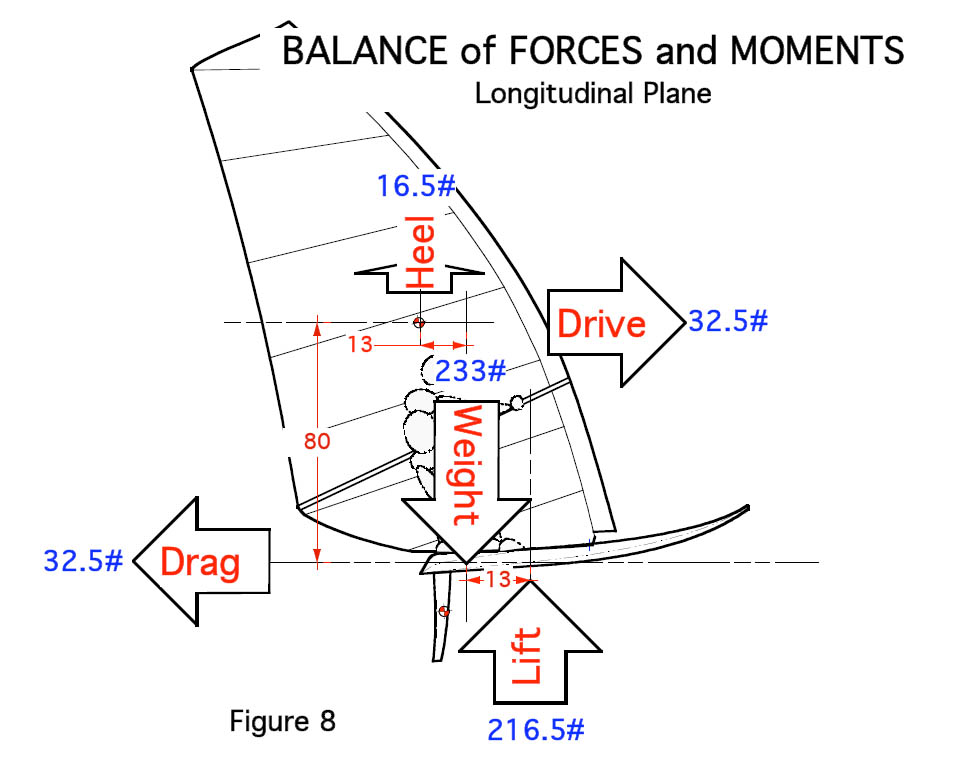
The weight estimate from Figure 5 lets us complete the balance of forces and moments introduced on Figure 3. Figure 6 is the result. Knowing that the weight of everything is 233 lbs and equalizing the moments around the intersection of the lift force and the  lateral fin force unlocks the puzzle by yielding a heel force of 63.7 lbs when the sail is  angled from vertical to windward by 15°. The horizontal component of heel is 61.6 lbs and thus is the force on the fin. The vertical component relieves 16.5 lbs of weight and lowers the lift required from the board to 216.5 lbs. The purpose here is to illustrate the process. The numbers change, of course, with different circumstances.

Estimating the hydrodynamic forces – lift and drag -- of marine bodies is an art more than a science. This is because the boundary between air and water, where most watercraft operate, is complicated by waves, chop, spray induced by the body, etc. And the task is quite a bit more difficult for a sailboard hull. Its small size magnifies the effects of waves and chop and its trajectory is in no sense “steady state.”

None-the-less, there is a happy feature to the drag of a planing hull, indicated in theory and born out in tests as illustrated in Figure 7. It is that the ratio of drag to lift, once planing occurs, is pretty much constant over a fairly large range of speeds provided that the board’s angle of attack is trimmed to minimize drag for each speed. That’s the job of the sailor. This feature of a planing board happens because, as speed increases, the board rises out of the water, reducing the size of the patch of water it rides on. This reduction in size more than offsets the increase in friction drag per unit area of that patch caused by the increase in speed. Other effects, spray, waves, etc., increase with speed, however. The net effect is that a well trimmed sailboard’s drag/lift ratio is around 0.15 for speeds from about 6 knots to well over 20 knots. Of course, different designs and different conditions can change this by a lot, perhaps ±0.05, but the phenomena of relatively constant drag with speeds above planing is a reasonable assumption. 
Figure 7 also shows the drag/lift ratio for the Hobie Cat mentioned above. At low speeds
-- below the windsurfer’s planing speed of about 6 knots -- the Hobie has the advantage. Its long slender hulls part the water gently and leave very little wake. This reduces energy dissipated in the wake, minimizing what is known as “wave making drag”. However, its hulls are not designed to plane and thus, as speed increases, “wetted area” stays the same and friction drag increases dramatically.


This flat drag/lift feature of planing hulls eases the next step in the analysis shown on Figure 8. This is another vertical plane but now parallel to the direction of travel,  referred to as the longitudinal plane. The weight and lift forces and the vertical component of heel are taken from Figure 6. Knowing that drag/lift is 0.15 over a wide speed range tells us that Drag is about 32.5 lbs. And the figure also shows that Drive is 32.5 lbs and that by equalizing moments around the sail’s c.p. the center of lift applied to the bottom of the board is 13 inches forward of the c.g.


To repeat the cautionary remarks from above, these estimates are only illustrative and can change with circumstances. Perhaps the most important of these is the sailor’s trimming of the board’s angle of attack relative to the water’s surface to minimize drag. The sailor does this by adjusting the longitudinal position of 1) his c.g. and 2) the sail’s c.p. while keeping all the forces illustrated in Figures 6 and 8 in balance. No small trick, as any beginner will tell you.

Figure 9
completes the three dimensional description of the steady state forces by viewing them on the horizontal plane of the combined board-rig-sailor body (omitting the sailor and rig for clarity). The interesting feature of this perspective is that all the horizontal forces interact at or behind the tail of the board. This feature is also unique to windsurfers as compared to all other sailing craft.
Part II – Velocity Vectors
Until this point there has been no need to specify the strength or the direction of the wind relative to the board or the speed of the board itself or the size of the sail. It’s been possible to ignore them in estimating heel and drive forces -- 63.7 lbs and 32.5 lbs, respectively -- because 1) heel forces are a reaction to the leverage produced by the sailor, whose weight and lever arm are known and 2) drive forces are equal and opposite to drag forces which, in turn, are assumed constant over the speed range of interest.

These forces are generated by what physicists call momentum transfer, that is, energy transfer between the air and the water. The agent of this transfer is the board, rig and sailor combination acting as a whole. A less precise but more understandable way of saying this, however, is that the sail and sailor “lean” against the approaching wind as the board and fin “lean” against the oncoming water. This process slows the wind and  accelerates the water.

There are three speeds of interest in the analysis to follow:
1) the true wind speed as felt by someone just floating in the water
2) the board speed as felt by the wet parts of the board and the fin and
3) the apparent wind speed as felt by the sail and the sailor.

These three form a triangle or a “closed” vector system. If two are known, the third is
also. {More correctly: a triangle has six properties, three sides and three angles between them. If
any three of the properties are known, the other three are determined, though some cases are ambiguous and others are impossible
.}


Taking up the apparent wind first, Figure 10 combines the heel and drive forces in their common plane, which, recalling Figures 6 and 8, is canted at 15° to the horizontal. The result is an aerodynamic force vector of 71.5 lbs at an angle of 64.7° to the direction of progress. {The magnitude and direction of this combined force is, in the real world, under the control of the sailor up to a limit placed by the strength of the wind. Before going out he will choose the size of sail on the basis of the wind’s strength and the contents of his sail quiver. On the water he controls the sail’s force through the trim (rotation) of the sail with his hands and harness lines, adjusting it to balance against his degree of windward hike and gain what he perceives is the maximum drive he can in the direction he has chosen}
This force is the net of all aerodynamic forces on the sail, the board and -- importantly -- the sailor. The combined force can also be estimated in another way using established aerodynamic formulae. This can be used as a check on the “Force and Moments” method of Part I and as a guide in equipment selection and/or sailing technique. And I think it’s interesting in its own right. It needs information on wind strength and direction, sail size and trim angle, namely, the same factors the sailor deals with. These aerodynamic formulae can also be used to calculate, say, the sail and board trim parameters needed to generate the combined force estimated by the “Force and Moments” method as a function of true wind direction, and along the way calculate the three speeds defined above. The next steps use this approach.

It is the convention in aerodynamics to divide forces into 1) forces perpendicular to the apparent or “local” wind but perpendicular also to the plane of the sail and 2) forces parallel to the direction of the apparent wind. The first is called the normal force because it is normal to the airflow, (normal being another word for perpendicular in fluid  dynamics.) It is analogous to the lift force on an airplane’s wing. The second is called the drag force. These two force vectors form a right triangle and add together with the familiar square root of the sum of the squares.

To illustrate, take a case where the true wind speed is 15 knots and where the sailor (a better than intermediate one) selects a sail size of 8 sq. meters to suit. Out on the water
Figure 11 shows the resulting relations between heel, drive, aero drag and aero lift.

The aerodynamic drag force is seen to be 10.7 lbs and normal force is 70.7 lbs. These vectors combine to provide the 71.5 lbs that the above Force and Moments analysis say is required to generate the required heel and drive. 


The aerodynamic drag in this example consists of about 4.5 lbs of drag on the sailor with the remaining 6.2 lbs divided between what is known to aerodynamicists as “induced” and “profile” drag. This is illustrated in an expanded scale in the lower left. Note that the sailor is, so to speak, a real drag on the system. Note also that the direction of the apparent wind is now known since, by definition, it is perpendicular to the normal force – aero lift -- and parallel to drag, namely 36.1° from the direction of travel.

The relation between aero drag and aero lift is considerably more complex than shown but the general relevance of the estimates pictured here is aided by the fact that the ratio of the aero drag to aero lift is always small for most points of sail and in any event doesn’t vary very much. Thus the estimate of angle between the apparent wind and the direction of travel doesn’t change much either.


Figure 12 completes a typical velocity vector diagram for the case of the board on a beam reach, namely with the true wind of 15 knots at 90° to the direction of travel. Solving the vector triangle results in a board speed of 20.3 knots. This board speed is well within the range where the assumption of constant drag/lift ratio applies. Also, the apparent wind is increased from the true wind speed to 25.2 knots by the board’s forward motion.


This is where Jim starts takin’ us for a ride :-)
------------------------------------------------------------------


The equations shown on Figure 12 are simplified versions of more complex relations used in fluid dynamics. The first says that the normal force on the sail (Lsail) is the product of a lift coefficient (CL – a function of sail trim and shape) , sail area (S) and a group of terms that represents the “dynamic pressure” of the air , i.e., air density (ρa), over twice the gravitational constant (2g) times the speed of the apparent wind squared (Va ²).

NOTES:
  • The optimum lift coefficient, (CL)opt , is that associated with a well designed (and rigged) sail that is trimmed properly for the direction of sail and strength of the wind. It can vary up to over 1.0 for downwind sailing. It is proportional to the angle of trim -- β -- in this case 6.8°
  • Dynamic pressure is the kind of pressure you feel on your hand when you stick it out a car window when traveling at high speed. The pressure increases as speed increases by the square of speed.
The second equation says that the lift force on the bottom of the board is the  product of another lift coefficient (CLb) , the square of the board’s width (b2) and the dynamic pressure of the water flowing past the board, i.e., water density (ρw), over twice the gravitational constant (2g) times the square of board speed (Vw²). {Vw squared - is that a lotta Volhswagons ? :-) sorry, I cannot resist}

NOTE: This lift coefficient contains terms for static lift and dynamic lift and is a function of the angle of attack (trim angle), the width of the board, the length of the patch of water the board planes on and board speed. It can vary from around 0.01 for a short wide board at high speed to 0.6 for a long narrow board at low speed.

But, of course, the wind isn’t always perpendicular to the course. Another important case is when the desired course is upwind. That case is shown on Figure 13 where the course is 60° off the wind. This reduces the apparent wind slightly to 22 knots but reduces board speed by about half to 10.3 knots, still enough to plane, however. Also speed-made-good-to- windward reduces that by half again to 5.15 knots, still a great deal better than almost any other sailboat in a 15-knot wind. The sailor in this case has to sheet in another 2.1° from a beam reach to maintain the 71.5 lbs required force in the slightly less apparent wind.
The last case, sailing well off the wind while still maintaining efficient airflow on the low-pressure side of the sail, is illustrated on Figure 14. By this estimate, board speed increases to 24.2 knots even though the apparent wind reduces to 15 knots but still at 36.1° from the direction of travel. This reduction requires the sailor to sheet in 12.4°from that required on a beam reach. The resulting lift coefficient (CL) of 1.1 is close to the maximum a sail can generate without stalling and causing a large increase in aero drag.
The case illustrated on Figure 14 is probably optimistic in the levels assumed for both board drag and aero drag but not by much. It is a good illustration, however, of the changes that occur as the board heads well off the wind. The most interesting observation in this case is that the board travels down wind faster than the wind itself. That is, the speed-made-gooddownwind is 16.2 knots compared to the true wind speed of 15 knots. Tacking downwind has been the preferred tactic for many high performance sailboat designs but the above property of a windsurfer is rare among sailing machines except those that sail on solid water, i.e., iceboats. {Now Jim has me excited - what happens on ice ??}
                                  ---------------------------------
It’s clear that the Physics of Windsurfing is a three-dimensional puzzle a lot like Rubik’s Cube. The difference is the scale is larger, the moves are more complicated and it’s better exercise – physically and mentally.


References for Jim Drake

For those readers interested in a more professional (and lengthy) explanation of the fluid dynamics involved, I would suggest two highly regarded sources: Fluid-Dynamic Drag by Sighard F. Hoerner, Library of Congress Catalog Card  Number 64-19666 and Fluid-Dynamic Lift, by Sighard F. Hoerner and Henry V. Borst, Library of Congress Catalog Card Number 75-17441.

The fundamentals of forces and moments on the movement of bodies and the manipulation of vectors are well explained in any elementary level physics text. A request by email to the author, olliedrake@aol.com, for a suggestion will be promptly honored.
------------------------------------------------------------------------------------------------------

I never wouda thunk the physics of windsurfing could appear so complex. It is after all, NOT as bad as it seems. When I sail boards or boats there are plenty of factors not discussed like tides, currents and generally watching out for all kinds of obstacles. For a race one wants to put everything on your side, butt in everyday sailing, I wonder how many people actually analyze angles to the wind ? Many entries on forums where people speak of speed and sail performance, I have seen such discussion. Perhaps I will try and pay more attention to that myself :-) Do NOT worry, there will be NO impact on my fun factor :-)

Jim Drake's Windsurf Physics

By chance I came upon this and felt it would be better presented if the figures were in the document. Jim Drake is synonymous with windsurfing and now works or consults Starboard. The original link was drake_chronicles.

Although this discussion is toned down for the masses, it still makes me smile cuz for me it's simple - water, wind and I :-)

================================================================

An Introduction to the Physics of Windsurfing
Jim Drake – 2005 

All sailboats including windsurfers use the wind for propulsion. Windsurfers differ greatly from all other sailboats, however, in three respects. First, the forces that are captured by the sail and that drive the board forward all go through the sailor -- literally. Second, the weight of the hull, the sail, the mast and everything else is far less than the weight of the sailor who controls it. And finally, even in zero wind the sailor can make substantial headway by “pumping” the sail from side to side, using it as an “air oar” or, more accurately, like a bird’s wing. The first two features are explained in this paper. The last, “pumping”, will not be further be treated except to note that current Olympic competitors use this technique extensively in the often light wind conditions that seem to plague the Games.
In Figure 1 Kevin Pritchard, the 2004 World Champion, demonstrates the first of the features described above. He literally holds the wind in his hands and directs the sail’s power to the board through his arms and legs. He controls the force and direction -- throttle and steering wheel -- with his grip on the boom. In this way he is both motor and pilot. This paper will discuss the physics of windsurfing in two parts. Part I summarizes the forces and moments that act on the board and rig as a whole. This section is intended for a general audience and is not as complete or as careful as some might wish. It trades precision for what I hope is improved clarity. Part II translates the forces described in Part I into velocity vectors. This necessarily requires additional background for its understanding in the field of fluid dynamics. Thus it’s not for everyone though the figures in this section can give a degree of insight even if the theory behind them is likely to be opaque to the general reader.

Part I – Forces and Moments
Kevin is back again on Figure 2. It shows the kinds of forces that nature confronts him with. His natural skills allow him to sense and react to these forces without really thinking about them. Most windsurfers are the same way but some, like myself and those to whom this paper is aimed, find that an analytical understanding is fun in itself and often helpful on the water.
The main forces can be grouped roughly into five categories:

  1. Hydrodynamic lift acting upward on the bottom of the board,
  2. Gravitational weight acting downward through the center-of-gravity (c.g.) of the combined mass of the   board, rig and sailor,
  3. Hydrodynamic side force acting sideways almost entirely on the fin (or fins in the case of a board with a centerboard) in reaction to sideways component of the
  4. Aerodynamic wind force acting on the sail at its center-of-pressure (c.p.) and
  5. Hydrodynamic drag on the board balancing the forward component of the wind on the sail.

The sideways component of the aerodynamic force on the sail is called heel; the forward component is referred to as drive. A useful method for the analysis of forces on a body (in this case the body is the combination of board, rig and sailor) is that if the forces and moments acting on that body in two orthogonal (perpendicular) planes sum to zero, the body is moving at constant velocity. This is called “steady state” and is by far the easiest case to analyze.
This method is applied to a vertical plane perpendicular to the direction of travel in Figure 3. This is also called the lateral plane. The forces pictured on figure 2 that Kevin has to cope with and which have a component in the lateral plane are those shown. Note that the sail’s heel force has a slight vertical component. The lever arm between the heel force and the force on the fin – 106 inches – can be measured directly from the equipment sitting on the beach. The c.p. of the sail is about 40% up the mast and about 35% of the distance from the mast to the trailing edge of the sail.

The lever arm between weight and lift varies, of course, with the strength of the wind, the size of the sail and other factors. However, it can be measured for a particular condition from a photograph taken from the rear such as Figure 4.
This isn’t Kevin but one of his colleagues and it gives a really dramatic view of how the sail and sailor combine to drive the board forward. Knowing the width of the board allows an estimate of the horizontal distance between the centerline of the board (i.e., the lateral center of lift on the bottom of the board) and the c.g. of the board-rig-sailor combination, namely 29 inches. {The locations of the each component’s c.g. can be estimated by eye with adequate accuracy and then combined by the well-known method of summing moments and dividing by the total weight.}

The next step in the analysis is to make an estimate of the total weight and the breakdown between major components. An example of this is Figure 5. This is helpful in estimating the c.g. position needed on Figure 4 but crucial, as we will see, on the figure to follow.

The weights of each component can vary depending on many factors but lie generally within the range given for each component. Data like this can be obtained from manufacturer’s specifications and brochures, easily found on the web.

Note the dramatic difference between the Formula windsurfer (the one pictured in Figures 1,2 and 4) and another very fast and exciting boat, the Hobie 14. The equipment – so called dead weight – of the Hobie 14 is seven times that for the Formula. (And that doesn’t even include the trailer for the Hobie 14.) The leverage this gives the sailor is the main reason why windsurfers have held and now again hold the world speed record under sail. 


The weight estimate from Figure 5 lets us complete the balance of forces and moments introduced on Figure 3. Figure 6 is the result. Knowing that the weight of everything is 233 lbs and equalizing the moments around the intersection of the lift force and the  lateral fin force unlocks the puzzle by yielding a heel force of 63.7 lbs when the sail is  angled from vertical to windward by 15°. The horizontal component of heel is 61.6 lbs and thus is the force on the fin. The vertical component relieves 16.5 lbs of weight and lowers the lift required from the board to 216.5 lbs. The purpose here is to illustrate the process. The numbers change, of course, with different circumstances.

Estimating the hydrodynamic forces – lift and drag -- of marine bodies is an art more than a science. This is because the boundary between air and water, where most watercraft operate, is complicated by waves, chop, spray induced by the body, etc. And the task is quite a bit more difficult for a sailboard hull. Its small size magnifies the effects of waves and chop and its trajectory is in no sense “steady state.”

None-the-less, there is a happy feature to the drag of a planing hull, indicated in theory and born out in tests as illustrated in Figure 7. It is that the ratio of drag to lift, once planing occurs, is pretty much constant over a fairly large range of speeds provided that the board’s angle of attack is trimmed to minimize drag for each speed. That’s the job of the sailor. This feature of a planing board happens because, as speed increases, the board rises out of the water, reducing the size of the patch of water it rides on. This reduction in size more than offsets the increase in friction drag per unit area of that patch caused by the increase in speed. Other effects, spray, waves, etc., increase with speed, however. The net effect is that a well trimmed sailboard’s drag/lift ratio is around 0.15 for speeds from about 6 knots to well over 20 knots. Of course, different designs and different conditions can change this by a lot, perhaps ±0.05, but the phenomena of relatively constant drag with speeds above planing is a reasonable assumption. 
Figure 7 also shows the drag/lift ratio for the Hobie Cat mentioned above. At low speeds
-- below the windsurfer’s planing speed of about 6 knots -- the Hobie has the advantage. Its long slender hulls part the water gently and leave very little wake. This reduces energy dissipated in the wake, minimizing what is known as “wave making drag”. However, its hulls are not designed to plane and thus, as speed increases, “wetted area” stays the same and friction drag increases dramatically.


This flat drag/lift feature of planing hulls eases the next step in the analysis shown on Figure 8. This is another vertical plane but now parallel to the direction of travel,  referred to as the longitudinal plane. The weight and lift forces and the vertical component of heel are taken from Figure 6. Knowing that drag/lift is 0.15 over a wide speed range tells us that Drag is about 32.5 lbs. And the figure also shows that Drive is 32.5 lbs and that by equalizing moments around the sail’s c.p. the center of lift applied to the bottom of the board is 13 inches forward of the c.g.


To repeat the cautionary remarks from above, these estimates are only illustrative and can change with circumstances. Perhaps the most important of these is the sailor’s trimming of the board’s angle of attack relative to the water’s surface to minimize drag. The sailor does this by adjusting the longitudinal position of 1) his c.g. and 2) the sail’s c.p. while keeping all the forces illustrated in Figures 6 and 8 in balance. No small trick, as any beginner will tell you.

Figure 9
completes the three dimensional description of the steady state forces by viewing them on the horizontal plane of the combined board-rig-sailor body (omitting the sailor and rig for clarity). The interesting feature of this perspective is that all the horizontal forces interact at or behind the tail of the board. This feature is also unique to windsurfers as compared to all other sailing craft.
Part II – Velocity Vectors
Until this point there has been no need to specify the strength or the direction of the wind relative to the board or the speed of the board itself or the size of the sail. It’s been possible to ignore them in estimating heel and drive forces -- 63.7 lbs and 32.5 lbs, respectively -- because 1) heel forces are a reaction to the leverage produced by the sailor, whose weight and lever arm are known and 2) drive forces are equal and opposite to drag forces which, in turn, are assumed constant over the speed range of interest.

These forces are generated by what physicists call momentum transfer, that is, energy transfer between the air and the water. The agent of this transfer is the board, rig and sailor combination acting as a whole. A less precise but more understandable way of saying this, however, is that the sail and sailor “lean” against the approaching wind as the board and fin “lean” against the oncoming water. This process slows the wind and  accelerates the water.

There are three speeds of interest in the analysis to follow:
1) the true wind speed as felt by someone just floating in the water
2) the board speed as felt by the wet parts of the board and the fin and
3) the apparent wind speed as felt by the sail and the sailor.

These three form a triangle or a “closed” vector system. If two are known, the third is
also. {More correctly: a triangle has six properties, three sides and three angles between them. If
any three of the properties are known, the other three are determined, though some cases are ambiguous and others are impossible
.}


Taking up the apparent wind first, Figure 10 combines the heel and drive forces in their common plane, which, recalling Figures 6 and 8, is canted at 15° to the horizontal. The result is an aerodynamic force vector of 71.5 lbs at an angle of 64.7° to the direction of progress. {The magnitude and direction of this combined force is, in the real world, under the control of the sailor up to a limit placed by the strength of the wind. Before going out he will choose the size of sail on the basis of the wind’s strength and the contents of his sail quiver. On the water he controls the sail’s force through the trim (rotation) of the sail with his hands and harness lines, adjusting it to balance against his degree of windward hike and gain what he perceives is the maximum drive he can in the direction he has chosen}
This force is the net of all aerodynamic forces on the sail, the board and -- importantly -- the sailor. The combined force can also be estimated in another way using established aerodynamic formulae. This can be used as a check on the “Force and Moments” method of Part I and as a guide in equipment selection and/or sailing technique. And I think it’s interesting in its own right. It needs information on wind strength and direction, sail size and trim angle, namely, the same factors the sailor deals with. These aerodynamic formulae can also be used to calculate, say, the sail and board trim parameters needed to generate the combined force estimated by the “Force and Moments” method as a function of true wind direction, and along the way calculate the three speeds defined above. The next steps use this approach.

It is the convention in aerodynamics to divide forces into 1) forces perpendicular to the apparent or “local” wind but perpendicular also to the plane of the sail and 2) forces parallel to the direction of the apparent wind. The first is called the normal force because it is normal to the airflow, (normal being another word for perpendicular in fluid  dynamics.) It is analogous to the lift force on an airplane’s wing. The second is called the drag force. These two force vectors form a right triangle and add together with the familiar square root of the sum of the squares.

To illustrate, take a case where the true wind speed is 15 knots and where the sailor (a better than intermediate one) selects a sail size of 8 sq. meters to suit. Out on the water
Figure 11 shows the resulting relations between heel, drive, aero drag and aero lift.

The aerodynamic drag force is seen to be 10.7 lbs and normal force is 70.7 lbs. These vectors combine to provide the 71.5 lbs that the above Force and Moments analysis say is required to generate the required heel and drive. 


The aerodynamic drag in this example consists of about 4.5 lbs of drag on the sailor with the remaining 6.2 lbs divided between what is known to aerodynamicists as “induced” and “profile” drag. This is illustrated in an expanded scale in the lower left. Note that the sailor is, so to speak, a real drag on the system. Note also that the direction of the apparent wind is now known since, by definition, it is perpendicular to the normal force – aero lift -- and parallel to drag, namely 36.1° from the direction of travel.

The relation between aero drag and aero lift is considerably more complex than shown but the general relevance of the estimates pictured here is aided by the fact that the ratio of the aero drag to aero lift is always small for most points of sail and in any event doesn’t vary very much. Thus the estimate of angle between the apparent wind and the direction of travel doesn’t change much either.


Figure 12 completes a typical velocity vector diagram for the case of the board on a beam reach, namely with the true wind of 15 knots at 90° to the direction of travel. Solving the vector triangle results in a board speed of 20.3 knots. This board speed is well within the range where the assumption of constant drag/lift ratio applies. Also, the apparent wind is increased from the true wind speed to 25.2 knots by the board’s forward motion.


This is where Jim starts takin’ us for a ride :-)
------------------------------------------------------------------


The equations shown on Figure 12 are simplified versions of more complex relations used in fluid dynamics. The first says that the normal force on the sail (Lsail) is the product of a lift coefficient (CL – a function of sail trim and shape) , sail area (S) and a group of terms that represents the “dynamic pressure” of the air , i.e., air density (ρa), over twice the gravitational constant (2g) times the speed of the apparent wind squared (Va ²).

NOTES:
  • The optimum lift coefficient, (CL)opt , is that associated with a well designed (and rigged) sail that is trimmed properly for the direction of sail and strength of the wind. It can vary up to over 1.0 for downwind sailing. It is proportional to the angle of trim -- β -- in this case 6.8°
  • Dynamic pressure is the kind of pressure you feel on your hand when you stick it out a car window when traveling at high speed. The pressure increases as speed increases by the square of speed.
The second equation says that the lift force on the bottom of the board is the  product of another lift coefficient (CLb) , the square of the board’s width (b2) and the dynamic pressure of the water flowing past the board, i.e., water density (ρw), over twice the gravitational constant (2g) times the square of board speed (Vw²). {Vw squared - is that a lotta Volhswagons ? :-) sorry, I cannot resist}

NOTE: This lift coefficient contains terms for static lift and dynamic lift and is a function of the angle of attack (trim angle), the width of the board, the length of the patch of water the board planes on and board speed. It can vary from around 0.01 for a short wide board at high speed to 0.6 for a long narrow board at low speed.

But, of course, the wind isn’t always perpendicular to the course. Another important case is when the desired course is upwind. That case is shown on Figure 13 where the course is 60° off the wind. This reduces the apparent wind slightly to 22 knots but reduces board speed by about half to 10.3 knots, still enough to plane, however. Also speed-made-good-to- windward reduces that by half again to 5.15 knots, still a great deal better than almost any other sailboat in a 15-knot wind. The sailor in this case has to sheet in another 2.1° from a beam reach to maintain the 71.5 lbs required force in the slightly less apparent wind.
The last case, sailing well off the wind while still maintaining efficient airflow on the low-pressure side of the sail, is illustrated on Figure 14. By this estimate, board speed increases to 24.2 knots even though the apparent wind reduces to 15 knots but still at 36.1° from the direction of travel. This reduction requires the sailor to sheet in 12.4°from that required on a beam reach. The resulting lift coefficient (CL) of 1.1 is close to the maximum a sail can generate without stalling and causing a large increase in aero drag.
The case illustrated on Figure 14 is probably optimistic in the levels assumed for both board drag and aero drag but not by much. It is a good illustration, however, of the changes that occur as the board heads well off the wind. The most interesting observation in this case is that the board travels down wind faster than the wind itself. That is, the speed-made-gooddownwind is 16.2 knots compared to the true wind speed of 15 knots. Tacking downwind has been the preferred tactic for many high performance sailboat designs but the above property of a windsurfer is rare among sailing machines except those that sail on solid water, i.e., iceboats. {Now Jim has me excited - what happens on ice ??}
                                  ---------------------------------
It’s clear that the Physics of Windsurfing is a three-dimensional puzzle a lot like Rubik’s Cube. The difference is the scale is larger, the moves are more complicated and it’s better exercise – physically and mentally.


References for Jim Drake

For those readers interested in a more professional (and lengthy) explanation of the fluid dynamics involved, I would suggest two highly regarded sources: Fluid-Dynamic Drag by Sighard F. Hoerner, Library of Congress Catalog Card  Number 64-19666 and Fluid-Dynamic Lift, by Sighard F. Hoerner and Henry V. Borst, Library of Congress Catalog Card Number 75-17441.

The fundamentals of forces and moments on the movement of bodies and the manipulation of vectors are well explained in any elementary level physics text. A request by email to the author, olliedrake@aol.com, for a suggestion will be promptly honored.
------------------------------------------------------------------------------------------------------

I never wouda thunk the physics of windsurfing could appear so complex. It is after all, NOT as bad as it seems. When I sail boards or boats there are plenty of factors not discussed like tides, currents and generally watching out for all kinds of obstacles. For a race one wants to put everything on your side, butt in everyday sailing, I wonder how many people actually analyze angles to the wind ? Many entries on forums where people speak of speed and sail performance, I have seen such discussion. Perhaps I will try and pay more attention to that myself :-) Do NOT worry, there will be NO impact on my fun factor :-)