
If my nonsense mistyping bothers you (or you enjoy it) please let me know :-)
When we speak of sails like this one, there is no need to distinguish the type of sailing one is about to do. No need to speak of wave (on shore, side shore), bump n jump, slalom, race, freeride, free-style, etc. This all came later...
In the 80's there were all kinds of things happening in the windsurf world. Robby Naish became a household name in the windsurf realm. In 1984 windsurfing became an Olympic event. Fred Haywood goes over 30 knots - perhaps on a sail designed by Barry Spanier. Full battens including foot battens make their appearance. Monofilm apparently made its appearance around here as well.
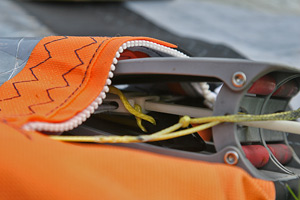 Other names in the sail industry were and still are Niel Pryde, Gaastra, Maui Sails, David Ezzy, Simmer Sails and others. It seems even camber inducers made it onto the scene this early.
 At the left is an example of an "exposed" cam inducer that illustrates how with the curvature, the batten is locked to the mast...
It was not just about going fast, but people were catching air and starting to do tricks like forward loops. However, the following chart shows that speed was definitely a factor.

Believe it was in the late 80's when Bruce Peterson of Sailworks discovered by accident the whole concept of the sail leech twisting and opening up. This allows sails to have much more range in that they do not become overpowered.
It seems stronger materials like X-ply made it into sails in the early 90's. And now in the 2000's there are newer, lighter, stronger and more expensive materials like technora...
Apparently it was not until the late 90's when camless sails came back into popularity. Today it seems the race, slalom and formula sails have the cams whereas most other sails do not... There is a light movement back to cams where there are only two(2) cams on the sail to provide stability...
At the beginning of this discussion, masts had little bend. Now masts have bend, twist and flex. As such it is important to put the correct mast on the sails. This is still only part of the equation. When rigging a sail many factors come into play besides the mast.
Now there are videos on sail sites, youtube and vimeo showing average joes how to rig camless and even cammed sails. Setting the mast extension correctly, putting enough downhaul, tightening battens and not too much outhaul all come into play.
Then of course for each person there are the additional factors of boom height, harness position, does one use adjustable outhaul, etc etc.
Today's sails range in size from 1.x square meters for kids to 12.x square meters. Cannot emphasize enough to get the matching mast that the sail maker has recommended. High winds call for sails in the 3.x to 5.x square meter range. Mid-winds are 6.0 to 8.5 and light winds are 8.5 to 12.x. This is a generalization because I have read about formula racers using 10.0 sails in quite high winds !!!
The good news is boards have sail ranges and sails have recommended uses. They are expensive, but at least they are repairable and my 2006 Pursuit monofilm sail is still going strong. Then again so is my 20 year old Dacron 7.0 3 cam sail. Still prefer my 10 year Gaastra Flow 3x over the 20 year NP sail.
As I write these notes to myself and whoever else is interested, I start to realize why starting windsurfing is difficult. There is a lot of information, expense, learning and very weather dependent. This is not to mention the equipment needs to be stored when not in use and a vehicle with which to transport it all.
Guess the lesson is, people should NOT start as I did, with a really old board and NO instruction. New gear is much more user friendly and there is a wealth of info on the web. For me the local shops are my biggest sources of information and I am more than happy to "encourage"/support them. All my new stuff is purchased locally and they answer questions via e-mail.
The latest n greatest is NOT required to have a GREAT time. I did discover though that the monofilm sail helped me get planing. Have planed with the older sails since, but after changing the fin. If one likes the great outdoors then sports like windsurfing and motorcycles are natural choices. I have yet to scream inside my helmet on my first windsurf session of the year. This was an annual routine for me on my old 750. I have made it to the smile and a whoop when I did a chop hop. Yes, windsurfing is thrilling and makes me feel closer to nature and my fellow man/woman.
Where I live two (2) boards and about three (3) sails should cover the majority of conditions for me. Since I really look to sail in all conditions, I will have three (3) boards and four or five sails... Just remember I had one board and three(3) sails for about 10 years to start :-)
Here is what I use for my sail reference => Sails vs Wind Speed

One sail I would like to give honourable mention is the "kitewing". It is referenced in the Winter Windsurfing section of this blog. It has no mast and generates plenty of lift...
Each time I sail , I learn new things about boom placement, harness line placement, etc and that is part of the fun as well..
Barry Spanier of Maui Sails uses the owl wing as a flight indicator and inspiration. Do not know why, but I prefer an insect wing - perhaps because due to its transparency one can see all the cells and re-inforcements.


No comments:
Post a Comment